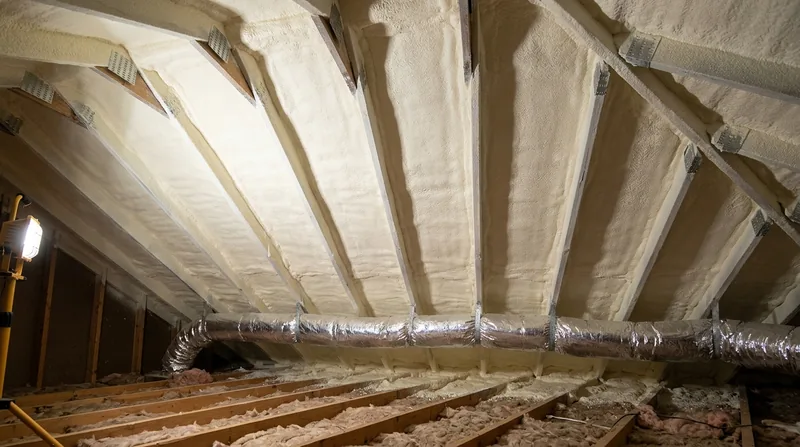




Attic spray foam insulation in Corpus Christi transforms a vented attic baking at 150 degrees Fahrenheit into conditioned space where your HVAC equipment and ductwork belong. The Coastal Bend sits in a brutal thermal corridor: summer heat radiates through the roof deck, salt-laden Gulf humidity pushes vapor inward year-round, and a concrete slab foundation means every home sits on a platform where air conditioning has to fight the ground and the sky at once. Open-cell foam sprayed directly to the roof deck stops that heat loss at the source, seals air leaks that fiberglass never touches, and puts the ductwork inside the thermal envelope where it actually works. Every estimate specifies the R-value, thickness per pass, and board footage so you know exactly what you are paying for.
Why Attic Spray Foam Insulation Matters in Corpus Christi's Heat and Humidity
Corpus Christi's attics fail in a way that fiberglass cannot fix. The vented attic design common in 1950s through 1980s homes pulls hot air through the soffit vents, lets it bake under the roof deck, and forces the air handler to work harder than it should. In summer, that attic hits 150 to 160 degrees Fahrenheit. The ductwork loses conditioned air through every seam and connection, and humidity condenses on cold supply lines. Spray foam to the roof deck eliminates the vented attic entirely: the roof becomes the building envelope, the ductwork stays cool, and the air handler runs at design capacity instead of fighting a 40-degree delta.
- Stops heat gain at the roof deck rather than trying to insulate around it after the fact.
- Seals every gap, seam, and penetration that fiberglass leaves open to air leakage and vapor.
- Keeps ductwork and the air handler inside the conditioned envelope so cooling efficiency actually improves.
- Controls humidity in the attic by eliminating the vented connection to outside air.
- Provides a solid substrate for mechanical ventilation during cure so no lingering odor remains after re-entry.
In Corpus Christi's climate, a sealed attic with spray foam is not a luxury upgrade; it is the answer to the physics that fiberglass ignores.
Key info: A Corpus Christi home with a 1,200 square foot attic vented at 150 degrees Fahrenheit loses an estimated 8,000 to 12,000 BTU per hour through the roof deck alone. Spray foam to the roof deck with proper thickness stops that loss and moves the attic temperature within 5 to 10 degrees of indoor air, cutting cooling load by 15 to 25 percent in a typical retrofit.
For guidance on what permits apply at your address, contact the City of Corpus Christi Planning and Development Services to confirm whether your attic spray foam work requires a permit and what the local building official requires for R-value, thermal barrier, and ignition barrier compliance.
How We Spray Foam Your Attic: The Process and Timeline in Corpus Christi
Attic spray foam insulation starts with a site walk where we measure the attic, identify the substrate (roof deck, rim board, band joist connections), check for moisture or ventilation conflicts, and quote the R-value and board footage you need. We then schedule the work, set up mechanical ventilation to run during cure and for 24 to 48 hours after, mask off any areas that should not be sprayed, and apply the foam in controlled passes so the thickness builds evenly and the ratio stays correct. After cure, we walk the job with you, verify the thickness and coverage, and explain the re-entry window. The whole process takes one to three days depending on attic size and complexity.
- We schedule a free estimate and walk the attic to measure square footage and identify any moisture, ventilation, or substrate concerns.
- We provide a written estimate with the R-value, thickness per pass, board footage, and the re-entry window for mechanical ventilation.
- We set up mechanical ventilation before spraying and run it continuously during cure and for 24 to 48 hours after application.
- We apply open-cell or closed-cell foam in controlled passes, maintaining the manufacturer ratio and drum temperature for proper cure.
- We verify coverage and thickness with you after cure and explain any maintenance or future considerations for your sealed attic.
- We help you understand what permits or inspections the City of Corpus Christi or your local building official may require.
The key to a professional attic spray foam job is mechanical ventilation during and after application, so the foam cures properly and no odor lingers in your home after you re-enter the space.
Local example: A Windsor Park ranch built in 1965 with a 1,400 square foot attic and existing blown-in fiberglass typically needs 5 to 6 inches of open-cell foam to the roof deck, or 3 to 4 inches of closed-cell foam, depending on the R-value target and the local building code. The work takes 2 to 3 days including ventilation setup and cure time.
If your attic also needs air sealing around rim joists, band joists, or ductwork penetrations, we handle that as part of the same job so the envelope is truly sealed.
Attic Spray Foam Insulation Methods: Open-Cell vs. Closed-Cell
| Approach | Description | Best for |
|---|---|---|
| Open-Cell Spray Foam | Lower density, softer foam that cures to R-3.6 per inch. Breathable, allows vapor to pass through, and provides sound dampening. | Corpus Christi attics where you want thermal performance and noise reduction, and where the roof deck is dry and ventilation is controlled. |
| Closed-Cell Spray Foam | Higher density, rigid foam that cures to R-6.5 per inch. Vapor barrier, structural, and resists moisture penetration. | Metal buildings, barndominiums, or Corpus Christi attics where condensation control or vapor barrier performance is the priority. |
| Removal and Re-Insulation | We remove failed fiberglass, blown-in, or existing spray foam, clean the substrate, and spray new foam to specification. | Attics where old insulation has settled, absorbed moisture, or is contaminated and needs complete replacement. |
| Top-Up on Existing Foam | If your attic already has spray foam but the R-value is below code, we add thickness to bring it into compliance. | Corpus Christi homes where a previous installer fell short or the building code has changed since the original installation. |
The choice between open-cell and closed-cell depends on your attic substrate, the humidity control you need, and the R-value target for your address. We specify both in the estimate so you can see the cost and performance trade-off.
Attic Spray Foam Insulation Cost in Corpus Christi: What to Expect
Attic spray foam insulation in Corpus Christi typically starts at $1.50 per square foot for open-cell foam on a straightforward roof deck, and moves to $2.50 to $3.50 per square foot for closed-cell foam or jobs with higher R-value targets. A typical 1,200 to 1,500 square foot attic retrofit runs $2,000 to $4,500 depending on the foam type, R-value specification, existing insulation removal, and substrate condition. The biggest cost drivers are the R-value you need (which the local building code sets), the thickness that R-value requires, and whether existing insulation must be removed before we spray.
- Open-cell foam costs less per board foot but needs greater thickness to reach high R-values, so a 30-inch depth may cost more than a 6-inch closed-cell application.
- Closed-cell foam is denser and more expensive per board foot, but delivers R-6.5 per inch so you reach code with less material.
- Removal of old fiberglass or failed foam adds $0.50 to $1.00 per square foot depending on the volume and disposal method.
- Attics with complex framing, multiple penetrations, or tight access cost more because the spray pattern is slower and more careful.
- The local building code R-value for your address sets the minimum thickness, so confirm the requirement before the estimate so the cost is clear.
Every estimate includes the R-value, thickness per pass, and board footage so you can compare quotes accurately. For a detailed breakdown of pricing by scope and foam type, see our full pricing overview.
What to Look for When Hiring a Spray Foam Insulation Contractor Near Corpus Christi
Spray foam insulation in Corpus Christi is not licensed at the state level in Texas, but the City of Corpus Christi and many surrounding cities require contractor registration before any work begins. Before you hire any spray foam contractor, ask for proof of municipal registration with the city where the work will be done, confirm that registration with the city directly, and verify that the contractor carries full insurance coverage. Get written estimates from at least two contractors so you can compare the R-value, thickness, board footage, and re-entry window. Ask about mechanical ventilation during cure: if a contractor promises immediate re-entry or says ventilation is not needed, walk away. Check references from recent jobs in Corpus Christi, Portland, or Rockport, and ask those homeowners about odor, cure time, and any issues after the work was done.
- Confirm that the contractor holds current municipal registration with the City of Corpus Christi or your local city, and verify it directly with the city before work begins.
- Ask for proof of full insurance coverage and request a certificate of insurance that names you as an additional insured for the duration of the work.
- Get a written estimate that specifies the R-value, thickness per pass in inches, total board footage, and the mechanical ventilation plan during cure.
- Ask how long the contractor has been doing spray foam work in Corpus Christi and request references from at least three recent attic jobs.
- Confirm what permits or inspections the local building official requires at your address, and ask the contractor to help you navigate the permitting process.
- Verify that the contractor will set up mechanical ventilation during application and run it for 24 to 48 hours after cure, not promise immediate re-entry.
A professional spray foam contractor in Corpus Christi will walk your attic, provide a detailed written estimate with all the specifications, explain the cure timeline and re-entry window, and help you confirm what your local building department requires. Call us at (361) 278-8446 for a free estimate and we will answer all your questions about the process, the cost, and what to expect after the work is done.
Attic Spray Foam Insulation in Corpus Christi: Pricing Guide
| Service | Price | Details |
|---|---|---|
| Open-Cell Spray Foam Attic | Starting at $1.50/sq ft | Thermal performance to R-3.6 per inch; typical 1,200 sq ft attic runs $1,800 to $2,400 depending on R-value target and existing insulation removal |
| Closed-Cell Spray Foam Attic | Starting at $2.50/sq ft | Vapor barrier performance at R-6.5 per inch; typical 1,200 sq ft attic runs $3,000 to $4,200 depending on thickness and substrate complexity |
| Insulation Removal and Re-Spray | From $0.50/sq ft removal plus foam cost | Removal of failed fiberglass or old spray foam plus new foam application; total cost depends on removal volume and new foam type |
| Complex or High-Access Attic | On estimate | Attics with multiple penetrations, tight framing, or limited access require on-site measurement to determine labor and material requirements |
| Travel and Mechanical Ventilation | Included | No mileage fee in Corpus Christi, Portland, Rockport, Kingsville, and surrounding service areas; ventilation setup and 24 to 48 hour cure monitoring included |
| Free Estimate | No obligation | Written estimate with R-value, thickness, board footage, and cost breakdown within 24 hours of contact at (361) 278-8446 |
Indicative pricing, the exact cost depends on square footage, finish, and site access. Free personalized estimate within 24h at (361) 278-8446.


