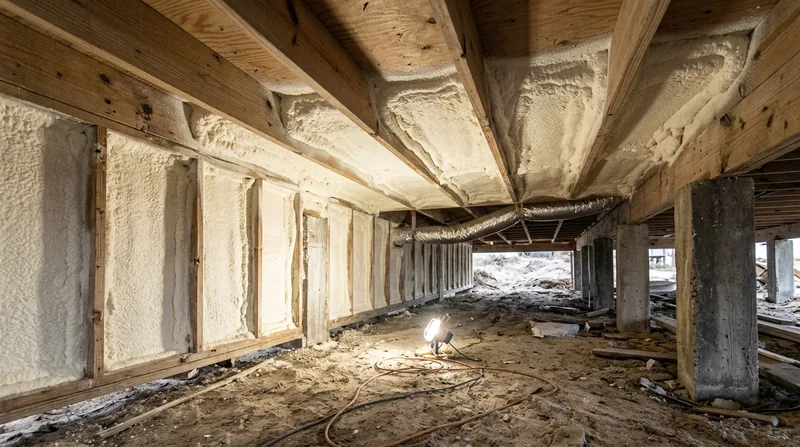




Pier-and-beam homes and raised properties across Corpus Christi, Portland, Rockport, and Port Aransas sit exposed to Gulf humidity year-round. Crawl space spray foam insulation seals the underside of these homes against moisture, salt-laden air, and the thermal load that keeps cooling bills high from March through November. Most Corpus Christi homes rest on concrete slab, but the older frame houses in Bayview, Del Mar, and Six Points, plus the elevated homes on Padre Island and the canal properties in Port Aransas, have open crawl spaces that pull humid air directly into the living space above. Closed-cell foam stops that infiltration at the source, survives storm surge, and holds steady in the salt air. We work on drainage first, then spray, and we build the envelope that keeps your interior stable and your energy bill honest.
Why Crawl Space Spray Foam Insulation Matters in Corpus Christi's Humid Coastal Climate
The Texas Coastal Bend sits in a salt-air corridor where humidity stays above 70 percent for eight months of the year. Crawl spaces with open vents pull that moist air directly into the rim joists, band joists, and subfloor framing above. Fiberglass batts absorb moisture, lose their R-value, and rot the wood they're meant to protect. Spray foam seals the boundary, stops the air leak, and survives the corrosive environment. In raised homes on pilings or pier-and-beam houses, closed-cell foam also resists storm surge better than any other insulation material.
- Closed-cell foam holds an R-value of 6.5 to 7.0 per inch and resists water infiltration and salt-air degradation.
- Sealed crawl spaces reduce the moisture load on air conditioning equipment and lower cooling costs year-round.
- Foam applied to the underside of the subfloor stops thermal bridging through concrete piers and wooden beams.
- A sealed crawl space keeps pests and rodents out more reliably than fiberglass or cellulose alone.
These benefits compound in homes built before 1980, where rim joists are often exposed and uninsulated, and in newer construction where energy code requires a thermal break below the subfloor.
Key info: Homes in Port Aransas and Rockport rebuilt after Hurricane Harvey often sit higher on pilings than their predecessors. Spray foam on the underside of the subfloor adds insulation and water resistance without reducing clearance or complicating future repairs underneath.
For official guidance on moisture control and energy code in your city, consult your local building department. Closed-cell spray foam insulation is the standard choice for crawl spaces because of its moisture resistance and structural durability.
How We Spray Crawl Spaces: The Process in Corpus Christi
We start by inspecting drainage and moisture. If standing water, active leaks, or soil saturation exists, we stop and tell you what needs fixing first. No foam goes down on a wet substrate. Once the space is dry, we prepare the rim joists, band joists, and rim beam by clearing debris and checking for gaps. We then spray closed-cell foam from the rim down to the subfloor, creating an air seal and a thermal barrier in a single pass.
- We inspect the crawl space for drainage problems, active moisture, or structural damage before any foam is ordered.
- We measure the rim joist, band joist, and subfloor perimeter to calculate board feet and provide a written estimate with R-value and thickness.
- We set up mechanical ventilation during application to manage fumes and meet cure-time safety windows.
- We spray closed-cell foam at the correct ratio and drum temperature, controlling thickness per pass to meet code.
- We establish a re-entry window of 24 to 48 hours and provide written guidance on safe access during cure.
The entire job from start to finish typically runs two to four hours for a standard crawl space, depending on perimeter length and access.
Real example: A 1,400-square-foot 1960s ranch in Westside Corpus Christi with a 120-foot rim joist and a 6-inch crawl space clearance received 4 inches of closed-cell foam on the rim and subfloor band. The homeowner saw a 12-degree drop in upstairs floor temperature in summer and a marked drop in humidity inside the house. The job took 3 hours and cost within the mid-range estimate because access was good and drainage was already in place.
For more detail on how air sealing ties into crawl space insulation, see our air sealing service page.
Crawl Space Insulation Methods: Closed-Cell vs. Open-Cell and Alternatives
Closed-cell foam is the standard for crawl spaces in Corpus Christi because it resists moisture, survives salt air, and does not absorb water. Open-cell foam is softer, cheaper, and breathable, but it absorbs moisture and is not suitable for wet or humid crawl spaces. Fiberglass batts and blown-in cellulose are cheaper upfront but lose R-value when damp and do not seal air leaks. The choice is determined by moisture risk and budget.
| Approach | Description | Best for |
|---|---|---|
| Closed-Cell Spray Foam | High-density foam at 3.5 to 4.0 pounds per cubic foot. R-value 6.5 to 7.0 per inch. Water-resistant and durable. Requires mechanical ventilation during cure. | Humid climates, salt-air zones, raised homes, storm-surge risk, rim and band joists, subfloor sealing. |
| Open-Cell Spray Foam | Lower-density foam at 0.5 to 0.6 pounds per cubic foot. R-value 3.5 to 3.7 per inch. Breathable and sound-dampening. Absorbs moisture and is not recommended for crawl spaces in humid climates. | Interior walls in dry climates, attic sound control, secondary insulation where moisture is not a concern. |
| Fiberglass Batts | Traditional insulation rolls or sheets. R-value 3.2 to 3.8 per inch. Does not seal air leaks. Absorbs moisture and loses R-value when damp. | Dry interior walls with vapor barriers, secondary insulation in climate-controlled spaces, budget retrofit where moisture risk is low. |
| Blown-In Cellulose | Recycled paper fiber blown into cavities. R-value 3.2 to 3.8 per inch. Does not seal air gaps. Absorbs moisture and settles over time. | Attic top-up in dry climates, secondary fill in sealed cavities, budget alternative where air sealing is not required. |
Closed-cell foam is the only choice for crawl spaces in Corpus Christi, Portland, and coastal areas where humidity and salt air are the dominant failure modes.
Crawl Space Spray Foam Insulation Cost in Corpus Christi: What to Expect
Crawl space spray foam insulation in Corpus Christi starts at $2,500 for a small rim joist and subfloor band on a compact home. The final price depends on the perimeter length, foam thickness, accessibility, drainage preparation, and whether existing insulation must be removed first. A typical 1,500-square-foot home with a 140-foot rim joist and good crawl space access runs $3,500 to $5,500 for 4 inches of closed-cell foam. Larger homes, difficult access, or homes requiring drainage work before foam can be applied will cost more.
Why the range? Perimeter length is the primary driver. A 100-foot rim costs less than a 200-foot rim. Foam thickness (usually 3 to 5 inches) is specified by code and your home's R-value requirement. Access matters: crawl spaces with low headroom or tight crawls slow the job and raise labor cost. Drainage issues must be resolved before foam is applied, so if your crawl space has standing water or seepage, drainage work is a separate cost.
Get 2 to 3 written estimates with R-value, thickness, and perimeter measurements spelled out. Compare the estimates side by side. A bid with no R-value and no thickness specification is a warning sign. See our full pricing overview for more detail on what moves the cost up or down.
We provide free estimates with no obligation. Call (361) 278-8446 or request a free estimate online. We respond within 24 hours and will visit your crawl space to take measurements and assess drainage before quoting a price.
What to Look for When Hiring a Crawl Space Spray Foam Insulation Contractor Near Me in Corpus Christi
The spray foam market in Corpus Christi includes local independents, national franchises, and out-of-state rigs that spray and disappear. Your job is to verify the contractor before signing. Here's what to check.
- Ask for proof of general liability insurance and workers compensation coverage, and verify the certificate directly with the insurance company.
- Request at least three references from jobs completed in the past 12 months in Corpus Christi or nearby cities, and call them.
- Ask for a written estimate that includes R-value per inch, foam thickness in inches, total board feet, and a breakdown of labor and materials.
- Confirm what permits are required for your address by calling your city building department, and ask the contractor how they handle permits.
- Check for any HOA architectural restrictions if you live in a master-planned community, and ask the contractor if they've worked in your neighborhood before.
- Ask how the contractor manages ventilation during application and what re-entry window they recommend after the job is done.
- Verify that the contractor will not spray over wet, leaking, or contaminated substrates, and will walk away if drainage is not fixed first.
An honest contractor will answer all of these questions clearly, provide verifiable references, and give you a written estimate with no surprises. If a contractor promises immediate re-entry, quotes a price far below market, or cannot provide insurance details, move on.
For help finding the right contractor in your area, contact us for a free consultation. We serve Corpus Christi, Portland, Rockport, Aransas Pass, Port Aransas, Kingsville, Robstown, Ingleside, and surrounding areas.
Crawl Space Spray Foam Insulation in Corpus Christi: Pricing Guide
| Service | Price | Details |
|---|---|---|
| Small rim and band joist (under 100 feet) | Starting at $2,500 | Closed-cell foam on rim, band joist, and subfloor band. Includes inspection, prep, foam application, and written estimate with R-value and thickness. |
| Standard crawl space (100 to 150 feet perimeter) | Starting at $3,500 | Full rim-to-subfloor seal with 4 inches of closed-cell foam. Cost rises with perimeter length, foam thickness, access difficulty, and any existing insulation removal. |
| Large or complex crawl space (150+ feet or difficult access) | Starting at $5,000 | Extensive perimeter, tight clearance, or drainage preparation required before foam. Final price set after on-site inspection and measurement of all conditions. |
| Drainage or moisture remediation before foam | On estimate | Standing water, active seepage, or soil saturation must be addressed before any foam is applied. Scope and cost determined by site visit and drainage assessment. |
| Travel within Corpus Christi and surrounding areas | Included | No separate mileage fee or call-out charge for jobs in Corpus Christi, Portland, Rockport, Aransas Pass, Port Aransas, Kingsville, Robstown, or Ingleside. |
| Free written estimate and inspection | Free | We visit your crawl space, measure perimeter and access, check drainage, and provide a written quote with R-value and thickness. No obligation to book. |
Indicative pricing, the exact cost depends on square footage, finish, and site access. Free personalized estimate within 24h at (361) 278-8446.


